What chair qigong actually is
Qigong is a practice of slow, deliberate movement coordinated with the breath. Done seated, the legs stop carrying you — which removes the balance problem, and moves the whole workout into the spine, the shoulders, and the breath.
That change is not a downgrade. It is a different training problem. When you are standing, your legs do most of the work and the torso follows. When you are seated, weight shift between the two sit-bones becomes the entire exercise — and almost every seated routine online skips this and just waves the arms around.
The one cue that changes everything
Before any arm movement: shift your weight onto your left sit-bone, then your right, slowly, ten times. That is the training. The arms ride along. If you only take one thing from this page, take that.
The eight movements
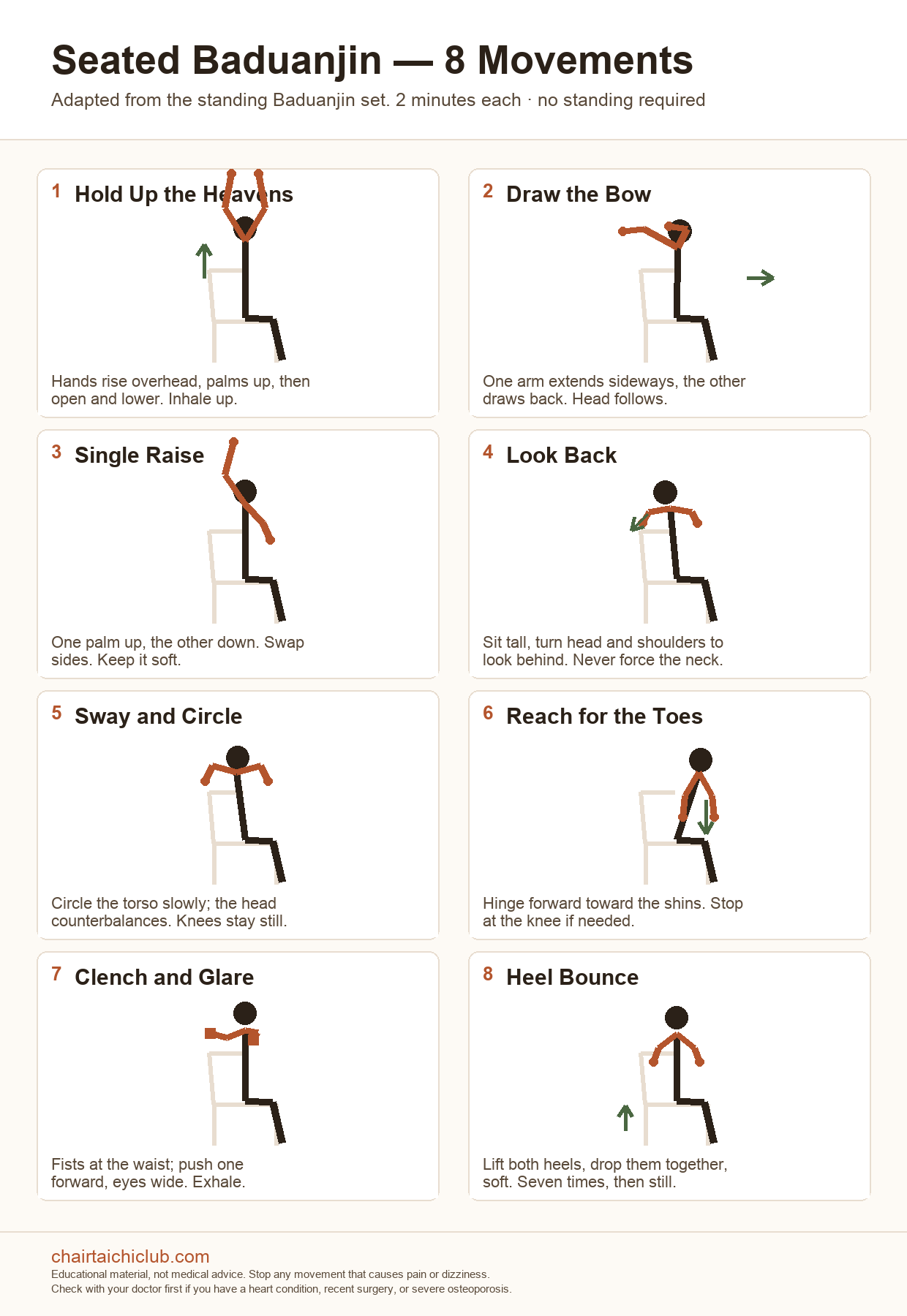
These are the eight Baduanjin movements, adapted to a chair. Ten minutes total, about 75 seconds each. The Chinese name is given because the English names are translations, not fixed terms — different books render them differently.
| # | Chinese | Movement | What you actually do | Breath |
|---|---|---|---|---|
| 1 | 两手托天理三焦 | Hold up the heavens | Hands lace at the belly, rise overhead palms up, then open and lower along the sides | Inhale up, exhale down |
| 2 | 左右开弓似射雕 | Draw the bow | One arm extends sideways, the other draws back at the shoulder; head follows the extended hand; swap | Exhale on the draw |
| 3 | 调理脾胃须单举 | Single raise | One palm pushes up overhead, the other presses down beside the hip; swap sides | Inhale up, exhale swap |
| 4 | 五劳七伤往后瞧 | Look back | Sit tall and turn the head and shoulders to look behind; do not force the neck | Exhale into the turn |
| 5 | 摇头摆尾去心火 | Sway and circle | Circle the torso slowly while the head counterbalances; the legs stay still | Continuous, no hold |
| 6 | 两手攀足固肾腰 | Reach for the toes | Hinge forward from the hips toward the shins or feet; stop at the knee if the back complains | Exhale down, inhale up |
| 7 | 攒拳怒目增气力 | Clench and glare | Fists at the waist, push one forward with the eyes wide; swap | Exhale on the push |
| 8 | 背后七颠百病消 | Heel bounce | Seated adaptation: lift both heels, let them drop together, soft and small, seven times | Natural |
One thing to be clear about
The standing Baduanjin set is a published standard. The seated version on this page is an adaptation — the same eight movements, ranges and support changed for a chair. It is not an ancient seated form. If you want the traditional seated system, that is the Twelve-Section Brocade, which really was written seated.
The same eight movements are taught standing, without a chair, on the Eight Brocades page. If you can stand safely, start there.
This is the same eight-move sequence taught on our Eight Brocades page, adapted for sitting. Standing practitioners should start there instead.
Four mistakes that make seated qigong useless
1. Letting the arms do the work
If your arms move and your ribcage does not, nothing is training. Fix: put one hand on your sternum and one on your belly for a whole movement. If the chest hand does not move, you are arm-waving.
2. Sitting all the way back
Slumping into the chair back removes the core work entirely. Fix: sit forward on the seat so your sit-bones carry you, and use the backrest only if you must.
3. Holding the breath at the top
Pausing to "feel the stretch" while holding the breath raises blood pressure in older adults. Fix: the breath never stops. Turn around at the top of the movement instead of stopping.
4. Going for range instead of smoothness
A bigger turn earns nothing and can irritate the shoulder. Fix: use about 70% of your comfortable range and keep the speed even — that is what trains control.
Free printable chart
All eight movements on one A4 or US-Letter page: large type, the breathing point marked at each phase, and a seven-day tick box. Print it at 100% scale and keep it beside the chair.
Watch the whole lesson before you buy anything
Sixteen minutes, all eight movements, English voiceover. Nothing is hidden — if it does not suit you, you will know within two minutes.
Sixteen minutes, all eight movements, English voiceover. The address in the corner of the video is this site. Open on YouTube →
Prefer to read? The printable chart below has all eight movements on one page.
Two ways to get it
The charts are the cheap way in. The video is the one that actually teaches you the sequence — sixteen minutes, English voiceover, every movement named on screen.
- Seated Baduanjin — the 8 movements, one page, with breathing cues and the Chinese names
- Chair Tai Chi — the 5 movements, a different set built on weight shift and rotation
- 30-day beginner plan — tick one box every three days
- Arthritis adaptation — which movements to modify, which to skip
- Seated balance version — weight shift from sit-bone to sit-bone
Instant download. Both A4 and US Letter included. Print at 100% scale.
- The full 16-minute lesson — every movement demonstrated, with Chinese movement names on screen and English cues burned in
- English voiceover throughout (male, slower pace for following along)
- Audio-only MP3 of the whole lesson — for practising without looking at a screen
- English subtitle file (.srt) if you want to read it or translate it
- Chapter markers for all eight movements
- Plus all five printable charts
Instant download: MP4 (1280p), audio-only MP3, subtitle file, chapter list, plus all five charts. About 29 MB total.
Facility print licence
For care homes, senior centres, community programmes and therapy clinics: print and hand out the charts to your residents or patients, on as many copies as you need, for twelve months.
Replies within two working days. Ask about a facility licence →
Is chair qigong the same as chair tai chi?
Not quite, and the difference matters for what you buy.
Chair tai chi takes tai chi form work — continuous, spiralling, one movement flowing into the next — and does it seated. It is form practice adapted downward.
Chair qigong is a fixed set of separate movements, each repeated a set number of times, with no form to memorise and no martial application. It is easier to learn and easier to do on a bad day.
If you have never done either, start with qigong. If you already know a tai chi form and want to keep the feel of it while seated, see chair tai chi.
Who this is for — and who it is not for
Good fit: older adults who cannot stand for a full class, people recovering from a hip or knee replacement once cleared, wheelchair users, anyone doing desk work who wants ten minutes of real movement.
Not a good fit without supervision: anyone in the first weeks after surgery, with an acute joint that is hot or swollen, with uncontrolled dizziness, or with severe osteoporosis. Seated practice is low-risk but it is not no-risk.
Frequently asked questions
How long should a session take?
Ten minutes for the full eight. If you only have three, do movements 1, 3 and 8 — open, rotate, close. That is the minimum useful sequence.
Can I do this in bed?
Movements 1, 2, 3, 7 and 8 work lying down with the knees bent. Movements 4 and 6 need the feet on the floor. If you are bed-bound, our seated balance version is the closer fit.
Do I need to be flexible to start?
No. Every movement has a reduced-range version on the chart. Range improves as a result of practice, not as a requirement for it.
Is this religious or spiritual?
No. The movements come from a health-exercise tradition; the breathing is slow and deliberate, not meditative in a religious sense. Many people do it while watching television.